
Potty Training a Puppy in a DFW Apartment: A Step-by-Step Guide for New Puppy Owners
By Puppy Dreams Editorial Team · June 16, 2026

To potty train a puppy in an apartment, choose one consistent outdoor spot, build a predictable schedule tied to meals and sleep, and learn your puppy's pre-potty signals so you can get outside before accidents happen. Consistency and a fast exit routine matter more than square footage. Most puppies adapt well to apartment life once the system is in place.
The boxes are still stacked in the corner. Your puppy has already peed twice, once on the mat, once on your shoe, and you haven't even found the can opener yet. This is potty training in apartments, and it's a different animal than anything the YouTube videos prepared you for. There's no backyard. Every bathroom trip can feel like a whole production: leash, elevator, the neighbor who wants to chat while your puppy is spinning in circles, and you doing mental math on whether you're going to make it outside in time. It's kind of a lot. And if you're in one of the apartment-dense communities around Carrollton, Arlington, or anywhere else in the DFW metroplex, you're definitely not alone in figuring this out. Apartment dogs get potty-trained all the time, not because their owners have more space or calmer puppies, but because they built a routine that actually worked for their setup and learned to catch the signals before things got desperate.
Why Is Apartment Potty Training Different?
Potty training in apartments is harder than house training because it often takes longer to get to a designated area, and a young puppy's bladder will not wait.
In a house, you can cover the distance between "I need to go" and "I'm going" in about four seconds. In an apartment, you're looking at two minutes on a good day. That matters a lot when you're working with a puppy whose bladder can only hold it for about one hour per month of age. A two-month-old puppy gives you roughly two hours of buffer, and that clock resets every time they wake up, eat, or finish a play session. You do the math at 2am when the elevator feels like it's taking forever.
Every bathroom trip feels like a whole production: leash on, out the door, down the hall, wait for the elevator, cross the lobby, find the spot. By the time you've done that a dozen times before noon, you start to understand why apartment potty training has a reputation.
Apartment dogs tend to come out of this experience as genuinely well-trained dogs, though. Not despite the difficulty but because of it. You have no choice but to be consistent. There's no yard to let them roam, no "close enough" potty spot, no flexibility in the routine. That rigidity, annoying as it is early on, is exactly what teaches a dog that the rules are the rules. The puppies who learn in tight quarters usually come out the other side knowing their stuff cold.
Before you head into step one, take a moment to pick a real spot, think of potential options, or find out if your complex has a designated puppy area. Be specific: not just "outside somewhere," but the actual patch of ground you'll walk your pup to every single time, rain or shine, half-asleep at 6am or rushing home at lunch.
Step 1: Choose Your Puppy's Designated Potty Spot
The best potty spot for an apartment puppy is a consistent outdoor location close to your building exit, ideally a patch of grass or quiet corner your puppy can return to every single time. Scent memory does the heavy lifting here, and it builds up over dozens of trips to that same patch of ground.
How Puppies Use Their Sense of Smell During Potty Training
Your puppy will begin to recognize the smell. Once they've gone in a spot a few times, it pulls them back almost automatically, before you've even asked them to go. So it doesn't matter if it's a scraggly triangle of grass near the side exit, a narrow strip along the front wall, or some forgettable concrete corner nobody else bothers with. What matters is that you pick one and keep going back to it. Even when it's raining, even if there's a closer exit, even if the walk takes longer than you'd like: go to the same spot every time. The consistency is what actually teaches them.
Puppies navigate the world mostly through smell. That same patch of ground, visited over and over, starts to carry a scent message: this is where we go. It sounds almost too simple, but location-switching genuinely muddies that signal. The consistency is the training.
Tips for Choosing a Potty Training Spot
Distance from your door matters more than you'd think in the first few weeks. Young puppies have almost no bladder control, and "almost no bladder control" is not an exaggeration. You want to be outside within seconds, not minutes. If your building has multiple exits, choose the one closest to your go-to spot and start training yourself to always use it too. In DFW apartment complexes, those green strips running along the perimeter near Carrollton or Addison communities tend to work well as a dedicated spot since they're close to building entrances and easy to reach fast.
Think about the weather before you need to. A rainy Tuesday at 6 am is not the moment to realize your spot is completely exposed. Walk the building now, find something with an overhang or a windbreak, and make that your backup. You will thank yourself for this.
Every potty trip is a leash trip. Not a sniff-the-whole-sidewalk trip, not a let's-see-where-we-end-up trip. You're outside for one reason, and the leash keeps your puppy focused on that reason. Once they go, then the fun can start.
Knowing where to take your puppy is a solid foundation. But knowing when to take them there is what actually builds the habit.
Step 2: Build a Schedule You Can Actually Keep
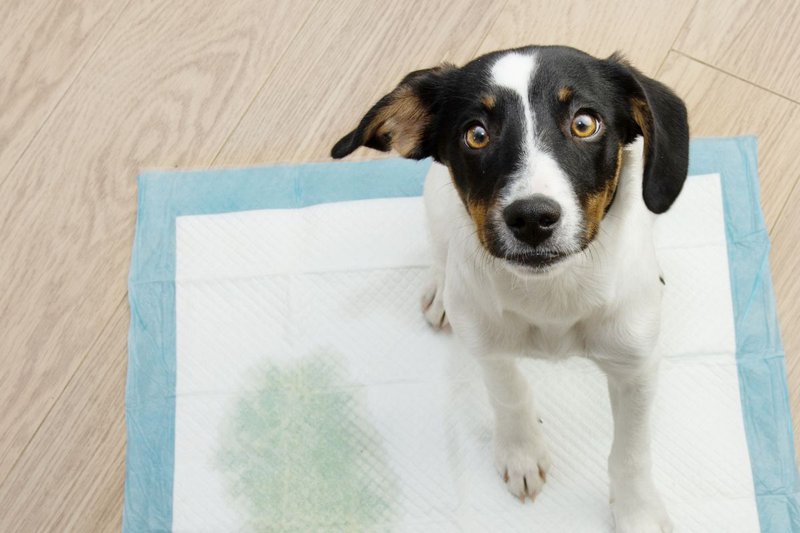
The foundation of potty training in an apartment is consistency. Young puppies need to go out every one to two hours, so be sure to set an alarm every 90 minutes. Plus, always take them out after:
- Eating
- Drinking
- Playing
- Waking up (even after short naps)
Other Tips for Building a Potty Training Schedule in a DFW Apartment
Set phone alarms. Seriously, set them. The first week, especially, your brain will not remember on its own, and "I thought I just took him out" is how carpets get ruined. Name the alarms something useful, like "puppy out NOW," so there's no snoozing and negotiating with yourself.
During that first week, jot down when accidents happen and when your puppy goes successfully outside. Even a quick note in your phone is enough. You'll start noticing patterns that belong to your specific dog: how they always need to go about 20 minutes after lunch or right when you sit down to work. That's the intel no generic puppy guide can give you. By the time most puppies hit four or five months, they can hold it for three to four hours, so the intensity right now is genuinely temporary.
There's a point, usually around week two, where the schedule becomes a daily habit, like second nature. You're not deciding to take the puppy out anymore, you're just doing it, the way you make coffee or lock the door. That's actually what you're building toward. Not a perfect record, but a rhythm your puppy's body can sync up with. When that happens, the accidents don't stop; they just become less random. However, while schedules can get you most of the way there, puppies don't always wait for your schedule.
You also have to learn what your specific dog looks like when they're about thirty seconds from going: the circling, the sniffing, the sudden distraction. Once you can spot that, you can actually do something about it.
Step 3: Learn to Read Your Puppy's Pre-Potty Signals
Puppies show clear signs when they need to go, and catching those signals early is the difference between making it outside and cleaning up the floor. Watch for sniffing the ground in tight little circles, abruptly stopping mid-play like someone hit pause, squatting, or whining and pawing at the door.
One of the clearest tells? Your puppy starts circling near the food bowl or rug for no obvious reason. That's not curiosity. That's a countdown. Young puppies have maybe 30 to 60 seconds once the urge hits, and that's if you're lucky.
In an apartment, that window shrinks fast. You've got a hallway, maybe stairs, probably a lobby between you and the nearest patch of grass. So reading the signal early isn't just helpful. It's the whole game. Keep your eyes on your puppy, especially in the half hour after meals or naps.
And every single time you head for the door, say your command word. "Outside." "Go potty." Doesn't matter what you pick, just pick one and use it every time without fail. Your puppy starts connecting that phrase to the action faster than you'd expect. Once you can catch the signal and get moving in seconds, the exit itself becomes your next hurdle.
Step 4: Master the Quick Apartment Exit
The fastest apartment exits happen because you prepared before your puppy gave a single signal. Speed wins in potty training in apartments. The exits that go smoothly aren't fast because you rushed. They're fast because you were ready. Leash by the front door, always. Not on a hook in the bedroom, not hanging off the closet knob down the hall. Right there at the door, so you can clip it on and be moving in under 10 seconds.
Walk your building's exit routes before you ever do this with your puppy. Time for both options if you have stairs and an elevator. Pick the faster one and use it every single time. When you leave, you're not checking the mail, not stopping for the neighbor. You are moving. Get to grass as fast as you can.
When your puppy finally goes, you've got maybe three seconds to mark it and get a treat in front of their nose. Not the boring biscuit you use for sit. Something they actually lose their minds over, so they start connecting going outside with something worth doing. That connection is what you're building, rep by rep.
Step 5: Handle Accidents Without Losing Your Cool
Accidents are a normal part of potty training a young puppy, and how you respond matters far more than how many happen. Most new puppy owners hit that moment where the accidents keep coming and it starts to feel like failure. It's not. Small puppies have tiny bladders and zero concept of your carpet's value. Accidents are going to happen, probably a lot of them, and that's completely normal.
What matters is how you handle it. If you catch your puppy in the middle of going, say "outside!" firmly and get them to their potty spot right away. That interruption is useful. What isn't useful is any kind of scolding or correction after the fact. Puppies genuinely cannot connect punishment to something that happened a few minutes ago. All they experience is you being upset, and that just builds anxiety without teaching them anything.
Every single accident needs enzymatic cleaner. Not a paper towel, not whatever spray is under your sink. Regular cleaners get rid of the smell for you, but your puppy's nose is working on a completely different level, and those scent compounds are still sitting right there in the carpet or floor. As far as your dog is concerned, you just marked that spot as the designated bathroom. Enzymatic cleaners break those compounds down instead of masking them, so there's nothing left for your puppy to find. If your puppy keeps returning to the same corner despite your best efforts, the cleaner is almost always the missing step.
When accidents keep piling up, the instinct is to correct more. Do the opposite. Go outside more. Add a trip right after meals, right after naps, right after play. Tighten the whole schedule by fifteen or twenty minutes and you'll usually see things shift pretty fast. If your building or your hours make that genuinely hard to sustain, an indoor potty option can cover the gaps without derailing the training.
When Do Indoor Potty Solutions Make Sense?
Indoor potty solutions make sense when outdoor trips aren't realistic given your puppy's age, your living situation, or the conditions outside. If you've got a puppy under 10 weeks old, their bladder control is pretty much nonexistent. Expecting them to hold it through a long hallway, a slow elevator, and a walk to the nearest patch of grass is setting both of you up for a bad morning. Same goes for high-rise living, extreme weather, or any mobility situation that makes frequent outdoor trips difficult.
Pee pads and indoor grass or turf patches are the two most common options. Both can work. Grass patches tend to be the better choice when you can swing it, because the texture stays consistent with what your puppy will eventually be using outside, and that connection matters.
Whichever you go with, treat the indoor spot exactly like you'd treat an outdoor one. One designated location, consistent timing, and a reward every time your puppy uses it correctly. An indoor option used that way genuinely supports the training process. Where it starts to slow things down is when it becomes interchangeable with outdoor trips, or when it gets placed in different spots around the apartment.
Pads just buy you time: your puppy's legs are writing checks their bladder can't cash yet, and that's fine. The reason they can't cash those checks is physical. A young puppy's bladder muscles are still developing, and they genuinely cannot hold it long enough to make it outside on demand. Pads give them a pressure-release valve during that developmental window, which is exactly what they need. But they don't replace the outdoor habit. That habit still has to be built in parallel, or when the bladder catches up, the training won't be there to meet it.
Frequently Asked Questions
How long does it take for potty training in apartments for new puppies?
Honestly, give it four to eight weeks before you expect real progress, and plan for four to six months before things feel truly reliable. Apartment life adds friction that a backyard setup just doesn't have: every single trip requires getting out the door, down the hall, possibly an elevator. That said, puppies on a tight, consistent schedule catch on faster than most people expect. The schedule does a lot of the heavy lifting.
Can you potty train a puppy without a yard?
You don't need one. Plenty of apartment puppies get fully trained using a grass patch near the building entrance, a corner of sidewalk, even a rooftop area. What actually matters is going to the same spot every time. Your puppy's nose does a lot of the work once a strong scent association builds up there.
What if my puppy will not go potty outside in bad weather?
Honestly, skipping the trip because it's drizzling is how you end up with a dog that stages a full protest every time the sky gets cloudy. Pull out a little rain jacket if they have one, head outside anyway, and when they actually go, lose your mind about it. Treats, praise, the whole thing. Puppies don't come pre-programmed to hate getting wet; they just need a few rounds of "wet paws equals best day ever" before it clicks.
Is it harder to potty train certain breeds in apartments?
Small breeds make more trips, no two ways about it. Tiny bladders fill fast. And yes, the reputation that Dachshunds and Beagles have for being stubborn is honestly pretty earned. Ask anyone who's trained one. But breed affects the timeline, not whether you'll get there. A real routine works on all of them eventually.
When should I stop using pee pads?
When your puppy is consistently moving toward the door on their own and indoor accidents have become genuinely rare, start the phase-out. Move the pad a little closer to the exit each week, then let it go. Keeping pads around too long sends a mixed message about where the bathroom actually is, and once that confusion sets in, it takes real effort to undo.
Are there local resources for new puppy owners in the DFW area?
Puppy Dreams in Carrollton is genuinely worth a visit. Drop in during a grooming appointment and just talk to the staff: they know the DFW area, they've dealt with every weird puppy situation you can imagine, and they'll actually tell you what's worth your time locally instead of just sending you home with a pamphlet.
You've Got This
With the right system, potty training in apartments can be reliably successful. Nobody's going to sugarcoat it for you. There will be 3 am elevator rides with a squirmy puppy. There will be accidents on the good rug. There will be a rainy Tuesday where you're standing on a wet sidewalk in your pajamas, wondering how you got here. The schedule is real work. The vigilance is real work. But so is the moment your puppy trots to the door and looks back at you, because they actually get it now. That moment is coming for you, probably sooner than you'd expect, and when it does, you'll know exactly how you got here.
The early morning trips aren't just about bladder training. You're learning your puppy's signals, their rhythms, the little tells they have right before they need to go. They're learning you, too. By the time the accidents stop, you've already built something. That part doesn't make it into most training guides, but ask anyone who's been through it, and they'll tell you the same thing.
Puppy Dreams has a Carrollton location that's worth knowing about if you're in the DFW area: the team there does grooming appointments and hands-on training support, and they're the kind of people who actually enjoy talking through the hard parts with you. You've done the work to get here; let them help with the next bit.