
Puppy Health Checklist for the First Year: Vet Visits, Vaccines, and More
By Puppy Dreams Editorial Team · June 22, 2026

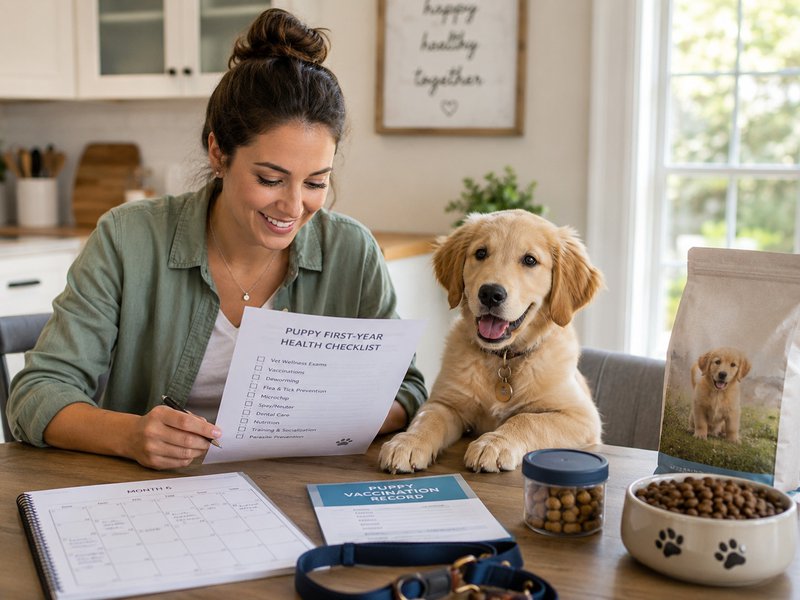
A puppy health checklist for the first year is your game plan for keeping a new dog alive and thriving during the stretch where everything matters most. Vet visits, vaccines, parasite prevention, what they eat, who they meet, when to spay or neuter. The first twelve months shape the next ten-plus years, and most people who've never raised a puppy before have no idea how fast the critical windows close. Get the roadmap. Follow it.
Key Takeaways
- Puppies need their first vet visit within 3-7 days of coming home.
- Core vaccines (DHPP and rabies) follow a three-appointment series in the first 16 weeks.
- Deworming starts as early as 2 weeks old and continues on a schedule through puppyhood.
- Flea, tick, and heartworm prevention should begin before your puppy is ever exposed.
- What your puppy eats in the first year directly shapes their adult health and size.
- The socialization window closes around 12-16 weeks, making early exposure essential.
- Spay/neuter timing depends on your puppy's breed and size, not a one-size-fits-all rule.
When Should a Puppy Have Their First Vet Visit?
That first week. Not when you get around to it. Within 3-7 days of bringing them home.
Look: a puppy can seem totally fine and still be carrying parasites, a heart murmur, something early that hasn't shown up yet. None of it announces itself. That's why you go. You're not just checking a box, you're actually finding out what you're working with before anything has a chance to get worse.
Your vet does a full head-to-tail check at that first appointment. Eyes, ears, heart, lungs, skin, all of it. They'll run a fecal screen for intestinal parasites, start building a health record, and map out a vaccine schedule for the months ahead. Bring every question you have too. Food, crate training, that weird sound your puppy made at 2am. That's exactly what the appointment is for. The AKC's guide to your puppy's first vet visit is worth reading before you go so you're not scrambling to remember things in the exam room.
Plan on going back every 3-4 weeks from about 6-8 weeks old until somewhere around 4-5 months. These aren't just booster appointments. Your vet is watching how your puppy develops, catching anything that might be quietly taking shape, and keeping immune protection current while your puppy's own system is still figuring itself out. It's a lot of trips but honestly that's the point of the first year.
What Vaccines Does a Puppy Need in the First Year?
Every puppy needs two core vaccines: DHPP and rabies. Full stop, regardless of where you live or how your dog spends their time.
DHPP covers distemper, hepatitis, parvovirus, and parainfluenza. These are highly contagious, and parvo especially can kill a puppy fast. Rabies is legally required in most states. These aren't optional based on lifestyle.
The sequence goes like this: first DHPP dose at 6-8 weeks, a booster at 12 weeks, the final dose at 16 weeks. Rabies comes somewhere in that 12-16 week window depending on your vet and your local regulations. The AKC's complete guide to first-year puppy vaccinations lays out the full timeline if you want it in front of you.
After core vaccines, your vet may bring up a few others. Bordetella (kennel cough) is pretty much standard if your puppy will ever set foot in a boarding facility, daycare, or dog park. Lyme is worth discussing if you're in a tick-heavy area. Leptospirosis comes up for dogs that will be around wildlife, standing water, or farms. Your vet will know what's relevant for where you are.
Puppy Dreams has both a first-year puppy vaccination guide and a printable puppy vaccine chart you can bring to appointments and actually use.
Vaccines cover a lot of ground. But not all of it. Deworming is a whole separate track, and it starts earlier than most people expect.
How Do You Deworm a Puppy and When?
Most vets start deworming at 2 to 3 weeks old, continuing every two weeks until 12 weeks, then monthly through 6 months. Yes, that's a lot of visits. But there's a real reason for it.
Puppies can actually inherit roundworms from their mother before they're even born. That's not a worst-case scenario, it's just how roundworm transmission works. Once your puppy arrives, parasites like hookworms and tapeworms can quietly interfere with nutrient absorption and slow healthy development. The reassuring part is that this is all completely routine.
At your puppy's early well visits, the vet will run a fecal exam, check for what's there, and prescribe the right medication. You bring the puppy. They handle the rest. No guesswork, no complicated home regimen. Most puppies get their dewormer, go home, and act like nothing happened. It's genuinely one of the less stressful parts of early puppyhood.
How Can You Protect Your Puppy from Fleas, Ticks, and Heartworm?
Flea, tick, and heartworm prevention can begin as early as 8 weeks old, and your vet will point you toward the right product based on your puppy's age, weight, and where you live. There are a few things worth understanding before you get started.
Fleas and ticks: Monthly preventatives work well when used consistently. Whether you go with a topical applied between the shoulder blades or a monthly chewable, either option does the job. What trips people up is focusing only on the puppy. Fleas don't live on your dog full-time. They're in the bedding, the carpet, the yard. Treating your puppy and the environment together is what actually breaks the cycle.
Heartworm: This one matters more than people sometimes realize. It spreads through mosquito bites, and by the time a dog shows symptoms, treatment is slow, expensive, and genuinely hard on the animal. Prevention is a monthly pill started at 8 weeks and kept up year-round. If you're anywhere in Texas, including DFW, mosquitoes are active enough for long stretches of the year that consistent prevention isn't optional. It's just part of the deal.
One rule that applies to everything above: check with your vet before using any parasite product on a young puppy. Some over-the-counter treatments aren't safe for puppies under 8 weeks, and a few can cause real harm. When in doubt, wait until you've talked to your vet.
Once parasite prevention is in place, the next piece of the foundation is feeding: what your puppy eats and how that fuels everything from energy to bone development.
What Should a Puppy Eat in the First Year?
Feed your puppy a food formulated specifically for puppies, not adult dogs, 3 to 4 times daily from 8 to 12 weeks, then drop to 2 to 3 meals as they get older. That "puppy" vs. "adult" label on the bag? It's not just marketing.
A puppy at 10 weeks is building muscle, bone, and brain tissue all at once. That takes more protein, more calcium, and more calories than any adult formula delivers. You won't see the shortfall happening. You might see it later.
So here's what to do when you're standing in that pet store aisle staring at a wall of bags: flip it over and find the AAFCO statement. You're looking for four words: "complete and balanced for growth." Not "all life stages" (though that works). Not "formulated to meet" anything. Growth validation specifically. That phrase means the food was actually tested against puppy nutritional standards. Not just designed to look expensive.
Wet vs. dry puppy food both work. A lot of owners mix them. The texture isn't the point. Quality and that AAFCO stamp are.
One mistake worth avoiding: switching to adult food too early. Small breeds are usually ready around 9 to 12 months. Large and giant breeds often need to stay on puppy food through 12 to 18 months. Their bones are still developing long after a Chihuahua has finished growing. Different animals on different timelines.
And keep these away from your dog entirely: chocolate, grapes, onions, and anything sweetened with xylitol. Toxic. No safe amount, no gray area.
Getting nutrition right in the first year sets your puppy up physically. What shapes them behaviorally starts right around the same time, and that window closes faster than most people expect.
When and How Should You Socialize a New Puppy?
Start early and be deliberate. The socialization window runs from 3 to 16 weeks, and whatever your puppy experiences during that stretch shapes how they respond to the world for the rest of their life. It doesn't reopen.
Socialization isn't just "let the puppy meet some people." It's intentional, positive exposure to the full range of things they'll encounter as an adult: strangers in hats and sunglasses, kids running and shrieking, the rumble of a garbage truck, hardwood floors, gravel, other dogs, car rides, the vet's office. Each new experience, handled well, builds a layer of confidence. Each one handled badly, or skipped entirely, leaves a gap that often shows up later as fear, reactivity, or aggression.
Short sessions beat long ones. A five-minute visit with a calm neighbor, a small treat, a little play afterward. That does more than an hour at a crowded farmers market where your puppy spends the whole time shut down and overwhelmed. Watch their body language. Ears back, tail tucked, trying to hide behind your legs? That's not socialization. That's stress. Back off and try something smaller.
Puppy classes are genuinely worth it. Once vaccines are partially complete, usually after the 12-week boosters (check with your vet), a good puppy class gives you structured, supervised exposure to other puppies in an environment designed for exactly this. The skills stick. So does the confidence.
The investment pays off in ways that are hard to overstate. A well-socialized puppy grows into a dog you can take places, a dog who recovers quickly from surprises, a dog who doesn't lunge at strangers or fall apart during thunderstorms. Puppy Dreams staff can also point you toward training resources and socialization guidance as you work through these early weeks.
Good nutrition and early socialization lay the foundation. One more health decision remains that affects your puppy's long-term wellbeing: spay and neuter timing.
When Should a Puppy Be Spayed or Neutered?
No single right answer. The research is genuinely messy on this one, and anyone who tells you otherwise is oversimplifying.
What most vets do agree on is that breed size changes the math significantly.
For small and medium breeds, around 6 months is typically the target, ideally before a female's first heat. These dogs mature faster, so earlier timing carries less risk developmentally.
Large and giant breeds are where it gets more complicated. A growing number of vets are pushing the recommendation to 12 to 18 months for bigger dogs. Their musculoskeletal systems need longer to finish developing, and there's real evidence that spaying or neutering too early can raise the risk of certain orthopedic problems in larger breeds. The science isn't settled. It has, however, shifted a lot of recommendations in recent years.
Why does it matter at all? For females, spaying eliminates the risk of pyometra (a serious uterine infection) and significantly reduces mammary tumor risk, especially when done before the first or second heat. For males, neutering removes testicular cancer from the table entirely and lowers the odds of prostate issues later on.
Here's the thing: your vet needs to make this call with you, not for you. Breed, size, growth rate, overall health. There's no universal age. There's just the right age for your specific dog.
Frequently Asked Questions
What should be on a puppy health checklist for the first year?
Vaccines (the DHPP series plus rabies), deworming, flea/tick/heartworm prevention, good food, socialization, and spay/neuter planning. That's the core of it. The first 16 weeks feel hectic but once you have a rhythm it genuinely gets easier. Start early. You'll feel the difference later.
How often does a puppy need to see the vet in the first year?
More than you'd expect at first. From around 6-8 weeks through 4-5 months, you're in roughly every 3-4 weeks to finish the vaccine series. After that it's a 6-month check, then once a year for healthy pups. Front-heavy, but totally manageable.
At what age is a puppy considered fully vaccinated?
Usually around 16 weeks, once the DHPP series is done and they've had their rabies vaccine. Your vet will likely want a booster at the one-year mark, then you'll shift to a longer 1-3 year schedule depending on your dog and your area.
What are the signs of a healthy puppy?
Alert, curious, eating well, bright eyes, pink gums, shiny coat. Those are your green lights. Unusual tiredness, skipping meals, loose stools that just won't resolve: don't wait on those. Call your vet. Early is almost always better and you'll kick yourself if you sit on something that turns out to be nothing to worry about anyway.
Your Puppy's Healthiest Year Starts with the Right Support
You've got the roadmap: vet visits, vaccines, parasite prevention, nutrition, spay/neuter timing. One milestone at a time, it's really not as overwhelming as it looks from the starting line.
What helps is knowing you don't have to figure it all out alone. Puppy Dreams has locations in Frisco, McKinney, Dallas, and throughout the DFW area, and honestly the staff there just genuinely love this stuff. Come in for dog grooming services, ask about training, or just stop by with questions. The Puppy for Life program is a real resource as your pup grows and things change over the months ahead. Find the Puppy Dreams location nearest you and let this first year be a good one.